Alexander Mandagie Paris
Dainty Blue Spanish Jacquard with Baduy Handwoven Fabric
Dainty Blue Spanish Jacquard with Baduy Handwoven Fabric
Couldn't load pickup availability
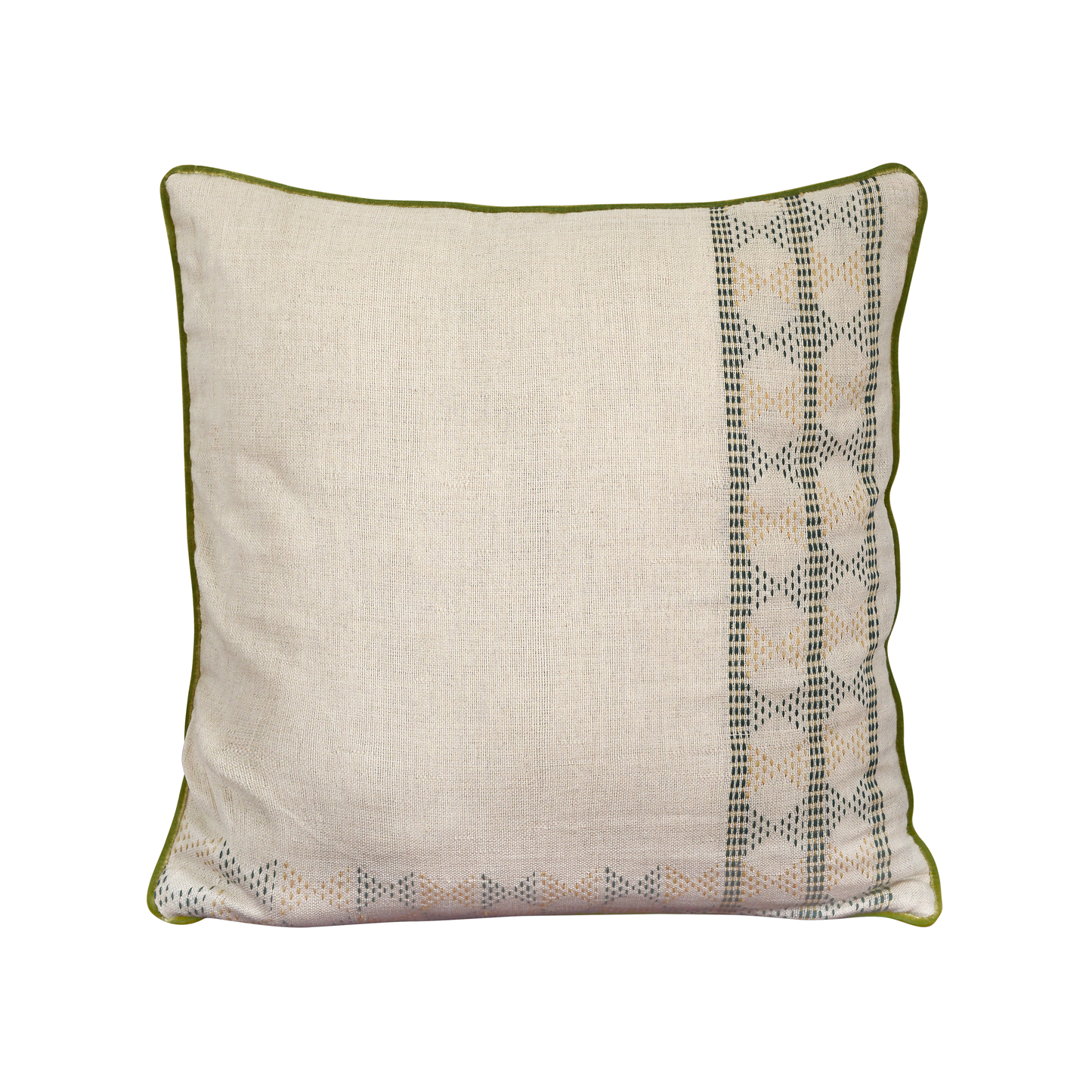
A Spanish beauty! This elegant square decorative throw pillow showcases an intricate floral and botanical pattern in muted sage green, terracotta, rust red, and lavender, set against a dusty blue-grey Spanish jacquard and finished with a slim olive green piped edge. The reverse is textured cream cotton carrying a vertical geometric stripe in black, beige, and green — hand-woven cotton, the result of more than 200 man-hours of work by Baduy artisans in Indonesia, coloured with natural dyes drawn from the trees and leaves of their region.
Every cushion is made to order, allowing for careful craftsmanship and close attention to detail. Your piece will be ready within 15 working days of the order date. It makes an excellent gift for yourself or for someone you love. Order yours today.
Dimensions: 45 cm x 45cm. Materials used for the front of the cushion: Spanish jacquard. Materials used for the back of the cushion: Handwoven fabric with natural dyes, designed by AMP's designer. All of our cushions are assembled in Paris, France. Specialised dry clean only.Kindly note the insert is not included. SKU: SJB1
---
Silk arrived in Iberia under Umayyad rule, bringing a form of state manufacture unfamiliar in the medieval West. The first ṭirāz workshop — a royal atelier producing inscribed fabrics as emblems of sovereignty — was founded at Córdoba under Abd al-Rahman II (r. 821–852), and by the eleventh century al-Andalus was the Mediterranean's principal supplier of silk. Production later concentrated at Almería, then Málaga and Nasrid Granada, before shifting to Toledo and Valencia under Christian rule. The surviving fabrics — samites and lampas silks worked with gold-wrapped thread — are recognisable for their disciplined geometry: banded compositions, roundels enclosing paired animals, calligraphy used as ornament. After the conquests, these vocabularies recombined into the Mudéjar-Gothic patterns catalogued by Florence Lewis May.
Almost all Andalusi silk survives because it was valued across a religious frontier: woven in Muslim workshops, then used to wrap relics, line reliquary caskets, and clothe Castilian royalty in burial. That is the durable point. Spanish prestige rests on synthesis — Muslim, Jewish, and Christian workshops supplying one another's markets — not on a single court style. Velvet proves it in reverse: absent from Islamic Spain, it entered only after the Christian conquest, carried in substantially by Italian artisans working in post-1492 Granada. A Spanish cushion earns its place the way those silks did. Strong repeating geometry reads clearly at small scale, holds against plain upholstery, and doesn't tire.
---
According to some, the central storytelling among the Baduy people is carita pantun, an oral epic sung by a specialist called Aki Pantun (or juru pantun) while playing the kacapi buhun. These performances are not casual entertainment; they are ritual obligations tied to rice planting, marriage, circumcision, and the opening of new settlement areas. The narratives recount the deeds of ancient Sundanese nobility—kings, queens, princes, and courtiers from the era of the Pajajaran and Galuh kingdoms—and encode moral and cosmological teachings for the community. A single performance can last an entire night, sometimes extending to three days and three nights, and the language preserves archaic Sundanese forms that most outsiders no longer understand.
Share