Alexander Mandagie Paris
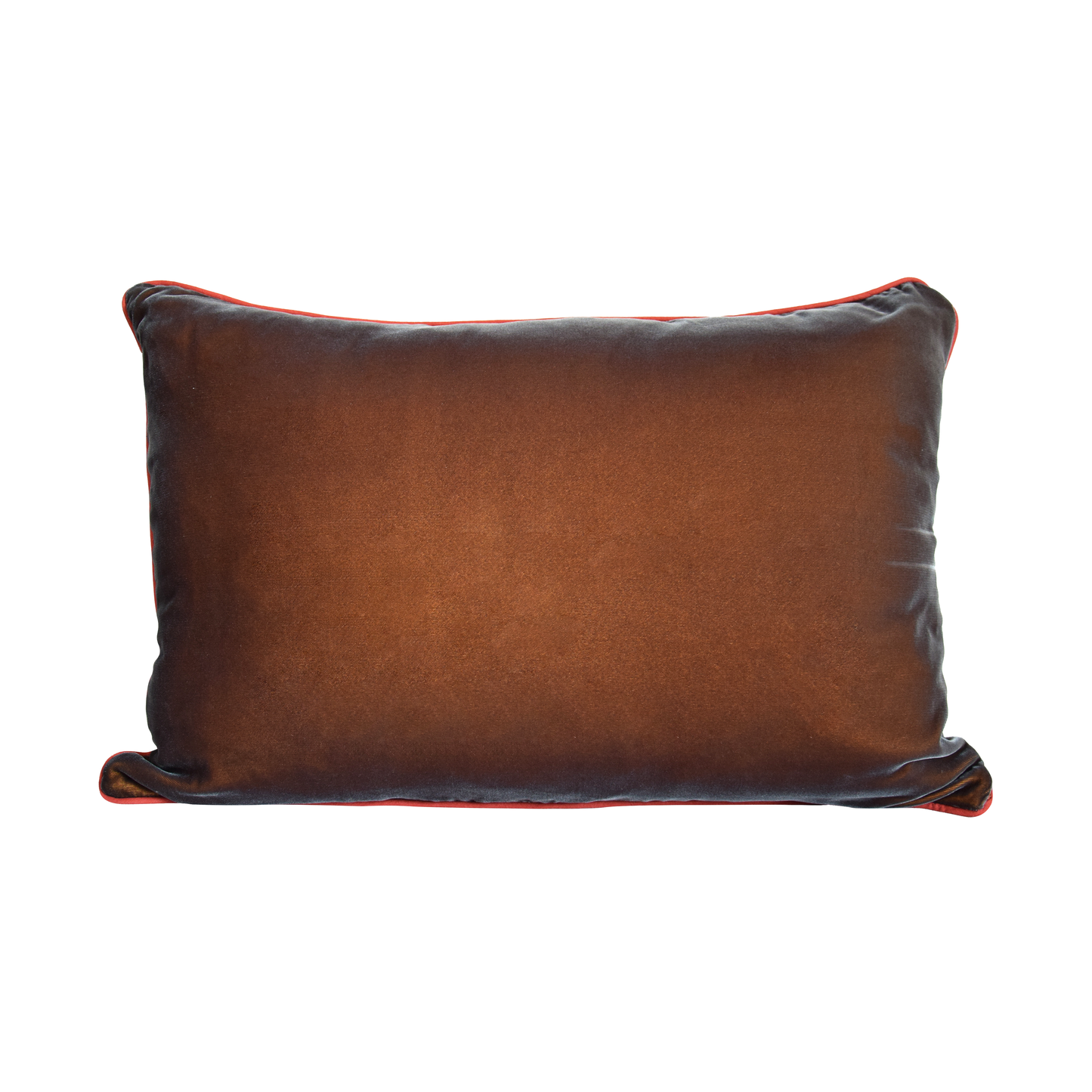
Earthy-tone 90 years Iranian Silk and French Velour Cushion - Heritage Collection
Earthy-tone 90 years Iranian Silk and French Velour Cushion - Heritage Collection
Couldn't load pickup availability
A scarce gem. A heritage collection. The front of the piece showcases a magnificent handcrafted Iranian wool-silk blend, distinguished by its remarkable age of over 90 years. This antique textile embodies the rich heritage and artistry of Iranian craftsmanship. The back is elegantly finished with luxurious Lyonnaise French silk velour, renowned for its refined texture and historical significance in French textile tradition. Together, these materials create a sophisticated fusion of Persian and French artistry, offering a unique blend of history, luxury, and cultural depth.
Each cushion is made to order, allowing time for careful craftsmanship and attention to detail. We will only produce 12 of this type. Your piece will be ready for shipping within 15 working days of your order date.
It will be a luxurious present for you or your family. We invite you to place your order now.
--
Dimensions: 60 cm x 40 cm. Materials used for the front of the cushion: Vintage handwoven wool-and-silk fabric, natural dyes. Materials used for the back of the cushion: Lyonnaise French silk velour. All of our cushions are assembled in Paris, France. Kindly note the insert is not included. Specialised dry clean only.
SKU : ILV002
-----
The Persian textile tradition stands as one of the foundational pillars of world decorative art. Reaching back to the Achaemenid and Sassanid empires and culminating under the Safavid dynasty (1501–1722), Persian carpet and fabric production developed a visual language of extraordinary density and refinement. Court workshops in Isfahan, Kashan, and Tabriz employed master weavers working under the direction of court painters, producing textiles of such complexity—hundreds of knots per square centimetre in the finest pile carpets—that the carpets themselves were understood as portable gardens, material manifestations of the Islamic paradise.
The iconographic vocabulary of classical Persian weaving—the islimi arabesque vine, the boteh (the leaf or paisley form later dispersed across global design), the radiant medallion, the field of repeated geometric stars—was not merely decorative but cosmological, encoding ideas about divine order, natural abundance, and the harmony between the human and celestial realms. Persian textile culture also produced the termeh, a handwoven wool or silk fabric of mesmerizing complexity still produced in Yazd, whose status as a carrier of aesthetic intelligence across centuries is unrivalled. It is from this deep reservoir of design philosophy that our Persian-inspired cushion fabrics draw their quiet authority and inexhaustible elegance.
---
French Textile Heritage
France's textile story runs through Lyon, the city that became Europe's silk capital. Louis XI tried to plant silk manufacture there in 1466, but local resistance pushed the project to Tours; it was François I who made it hold, granting letters patent in 1536 that installed the Piedmontese merchants Étienne Turquet and Barthélemy Naris in the city, followed in 1540 by a monopoly on raw silk imports. By the reign of Louis XIV, Lyon's workshops were producing silks, velvets and brocades of such refinement that they became instruments of courtly display and national prestige. Their visual vocabulary — floral motifs, baroque scrollwork, and later the narrative scenes of Toile de Jouy, printed at Jouy-en-Josas from 1760 — dressed palaces, churches and aristocratic houses, binding textile design into the identity of French luxury.
The skill behind these fabrics lived in trade corporations and family ateliers, where technique passed from one generation to the next. In Lyon, master weavers worked the drawloom, an intricate apparatus that required a second pair of hands to lift the pattern threads, to produce figured silks long before Jacquard mechanised the process in 1804. In Normandy, Alençon built its reputation on needle lace after Colbert established a royal lace workshop there in 1665; in Artois, Arras became known from the seventeenth century for a fine white bobbin lace.
On a luxury cushion, this inheritance shows up as fabric that balances opulence with restraint: dense damasks, softly lustrous silks, printed linens that recall the poise of eighteenth-century interiors. Each weave carries a tradition in which textile design was treated as a major art — commissioned by kings, refined by artisans whose names are sometimes recorded and often not, but whose standards still govern the thread.
Share