Taxes included.
This dazzling cushion features authentic Peranakan batik from Lasem, a northern coastal town in Central Java, Indonesia, that reflects the region’s rich heritage and intricate motifs.It took the artisan 100 hours, spread over two ot three months, to make this batik.
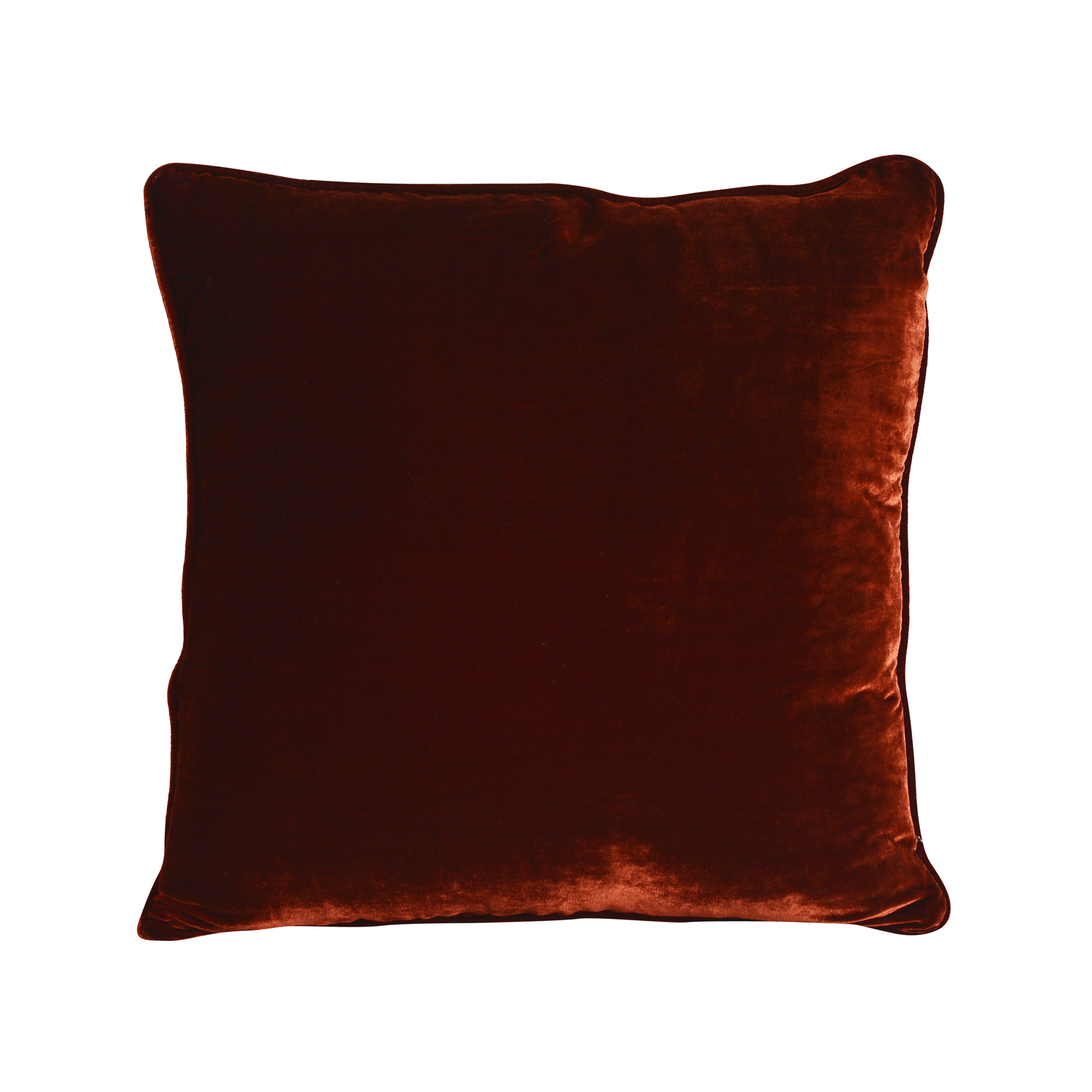
The back is crafted from luxurious French silk velvet, renowned for its softness, elegant sheen, and enduring quality, adding a touch of European refinement to the piece. This unique cushion beautifully unites Indonesian craftsmanship and culture with the timeless sophistication of French textiles, making it a striking accent for any interior.
Each cushion is made to order, allowing time for careful craftsmanship and attention to detail. Your beautiful piece will be ready within 15 working days from the date of order. It is an excellent present for you and your loved ones. We invite you to place your order now.
---
Dimensions: 45 cm x 45 cm. Materials used for the front of the cushion: Hand-drawn Batik fabric made from 100 % cotton. Materials used for the back of the cushion: Lyonnaise French silk velvet. All of our cushions are assembled in Paris, France. Specialised dry clean only. Kindly note the insert is not included.SKU: LBF002
---
Lasem Batik
On the north coast of Central Java, the small port of Lasem earned the name "Little China" for the depth of its Chinese-Javanese heritage. For centuries, its Peranakan families — descendants of Chinese settlers long rooted in Java — ran the workshops that made Lasem one of the archipelago's most distinctive batik towns.
Onto pasisir, or coastal, batik, the Lasem ateliers brought a Chinese vocabulary — the phoenix, the qilin, the lotus, the auspicious fret and coin — set among the flowing motifs of the Java Sea. The result is one of Indonesia's clearest examples of two civilisations composing a single, graceful cloth. That spirit of fusion — European and Asian sensibilities meeting without erasing one another — is exactly the conversation a well-made cushion can continue in a contemporary room.
Lasem keeps a founding story in which cloth and love are inseparable. Local tradition, preserved in the town's old chronicle, tells of Bi Nang Un, who is said to have arrived with the great maritime expeditions from China, and of his wife, Na Li Ni — remembered as the woman who first brought the art of batik to Lasem's shores.
In the telling, it is she who set down the patterns the town would make its own: the phoenix, the curling seaweed of the local coast, and above all, the celebrated red. A husband's voyage across the sea and a wife's patient hand are thus held to stand at the very origin of Lasem's craft — a marriage from which an entire textile tradition is said to descend. For a town built on the meeting of peoples, it is fitting that its proudest art should be remembered as the gift of a married pair who made a distant shore their home.
---
French Textile Heritage
France's textile story runs through Lyon, the city that became Europe's silk capital. Louis XI tried to plant silk manufacture there in 1466, but local resistance pushed the project to Tours; it was François I who made it hold, granting letters patent in 1536 that installed the Piedmontese merchants Étienne Turquet and Barthélemy Naris in the city, followed in 1540 by a monopoly on raw silk imports. By the reign of Louis XIV, Lyon's workshops were producing silks, velvets and brocades of such refinement that they became instruments of courtly display and national prestige. Their visual vocabulary — floral motifs, baroque scrollwork, and later the narrative scenes of Toile de Jouy, printed at Jouy-en-Josas from 1760 — dressed palaces, churches and aristocratic houses, binding textile design into the identity of French luxury.
The skill behind these fabrics lived in trade corporations and family ateliers, where technique passed from one generation to the next. In Lyon, master weavers worked the drawloom, an intricate apparatus that required a second pair of hands to lift the pattern threads, to produce figured silks long before Jacquard mechanised the process in 1804. In Normandy, Alençon built its reputation on needle lace after Colbert established a royal lace workshop there in 1665; in Artois, Arras became known from the seventeenth century for a fine white bobbin lace. A few houses still carry that thread: Tassinari & Chatel (founded 1680) and Prelle (founded 1752) reweave historic patterns from their own archives for Versailles and other palaces, drawing on period records and hand looms alongside modern equipment, while Hermès has its tie silks woven and finished in the Lyon region.
On a luxury cushion, this inheritance shows up as fabric that balances opulence with restraint: dense damasks, softly lustrous silks, printed linens that recall the poise of eighteenth-century interiors. Each weave carries a tradition in which textile design was treated as a major art — commissioned by kings, refined by artisans whose names are sometimes recorded and often not, but whose standards still govern the thread.