Alexander Mandagie Paris
Green Bentenan and Italian Silk Velvet
Green Bentenan and Italian Silk Velvet
Couldn't load pickup availability
This stunning 50x50 cm cushion features authentic Bentenan fabric from Minahasa, a tribe from the North Sulawesi region of Indonesia, on the front, handwoven by local artisans using traditional techniques and natural plant-based dyes that reflect the region’s rich heritage and intricate motifs. One piece of this traditional handwoven textile emerged from 200 hours of dedicated artisan work carried out over two or three months.
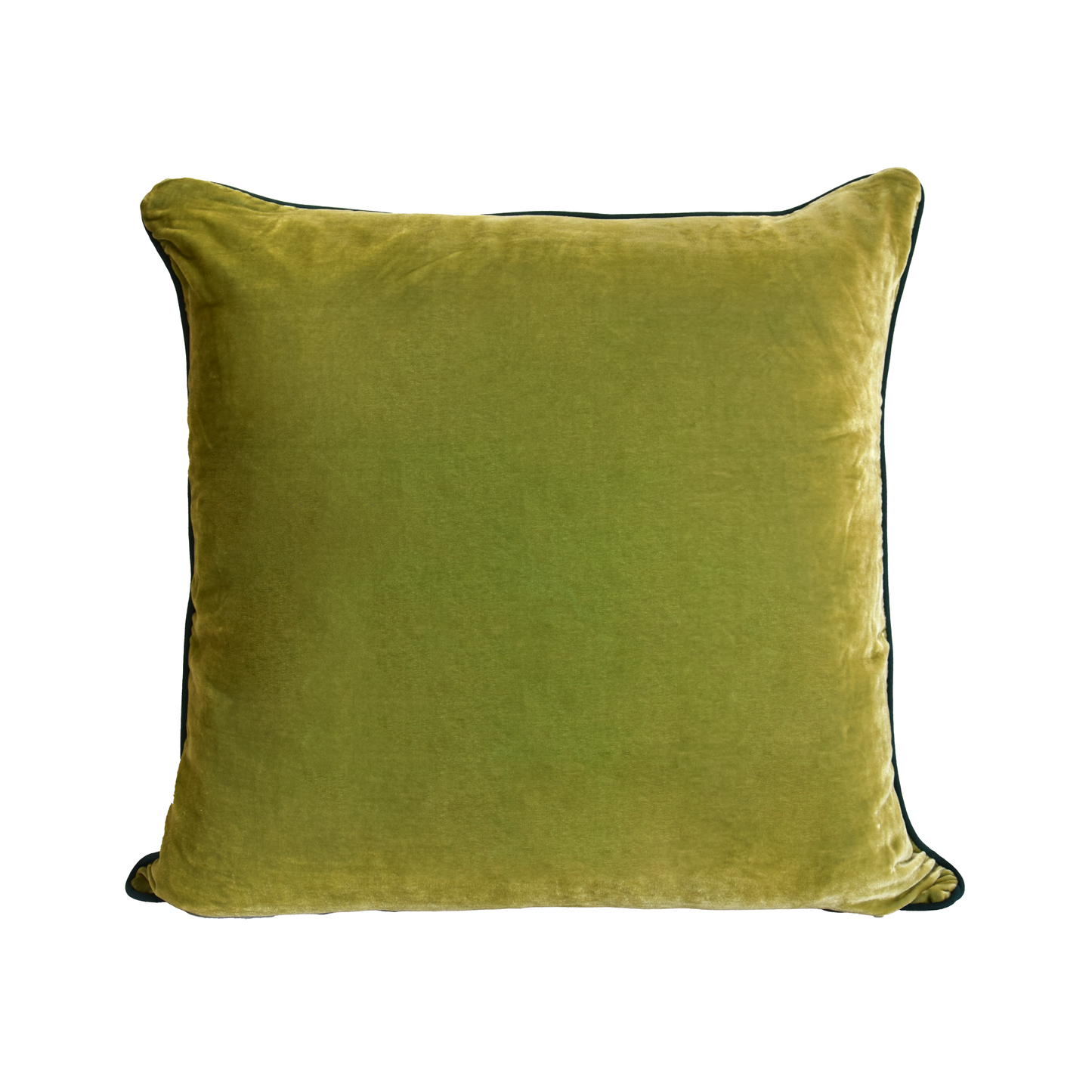
The back is crafted from luxurious Italian silk velour, renowned for its softness, elegant sheen, and enduring quality, adding a touch of European refinement to the piece. This unique cushion beautifully unites Indonesian craftsmanship and culture with the timeless sophistication of Italian textiles, making it a striking accent for any interior.
Each cushion is made to order, allowing time for careful craftsmanship and attention to detail—a perfect gift to reflect your style and taste. Your piece will be ready for shipping within 15 working days of the order date. We invite you to place your order now.
---
Dimensions: 50 cm x 50 cm. Materials used for the front of the cushion: Handwoven cotton with artisanal natural dyes. Materials used for the back of the cushion: Italian silk velvet. All of our cushions are assembled in Paris, France. Specialised dry clean only. Kindly note the insert is not included.SKU : BEV002
---
A Minahasan legend says that long ago, on the slopes of Mount Wulur Mahatus in North Sulawesi, a sweating rock gave birth to a woman named Karema. From a split in that same rock came a second woman, Lumimuut, whom Karema raised as her daughter. One day, facing the west wind in a ritual, Lumimuut miraculously conceived and bore a son, Toar. The three lived together until Toar grew into a strong young man; then Karema declared it time for him and Lumimuut to wander the world and find spouses, giving each a staff of equal length with a warning: if they ever meet someone whose staff matches theirs, that person is family and must not be married.
Toar travels north while Lumimuut goes south; as he journeys, his staff lengthens. Years later, under a full moon, Toar meets a beautiful woman and, following Karema’s rule, compares their staffs. They are no longer the same length, so they marry, only to discover by morning that she is Lumimuut—his mother, now eternally youthful. Their union, witnessed by the stars on the mountain later called Lolombulan, becomes the origin of the Minahasa people. The tale is at once a creation myth and a poignant, unsettling love story about destiny, recognition, and the founding of a lineage.
---
Italy's textile heritage did not develop as a single tradition but as a web of regional crafts. Silk-making took hold in centres such as Lucca, Venice, Florence, Bologna, Genoa, Milan and Naples, with Piedmont rising later, while other towns built their reputations on wool and linen. Scholarly surveys trace Italian silk from the Middle Ages through the early modern period, when guild oversight, specialised dyeing, intricate loomwork, and richly patterned cloth put Italian output at the heart of European luxury production. This history is set out in La seta in Italia dal Medioevo al Seicento: Dal baco al drappo (2000) and in 5000 Years of Textiles (1993), the latter situating Italian silks within the wider story of European textile innovation.
In interior design, the standing of Italian textiles rests on technical discipline rather than decoration alone: a controlled lustre, exacting weave structure, and centuries of association with civic wealth, patronage and ceremony. A cushion cut from Italian cloth is thus more than an ornament — it is a small distillation of a culture that has long treated fabric as a kind of architecture for the body and the room, lending a living surface to memory, craft and proportion.
Share