Alexander Mandagie Paris
Fuschia Bentenan and French Silk Velvet
Fuschia Bentenan and French Silk Velvet
Couldn't load pickup availability
This striking cushion pairs vibrant fuchsia and violet hues with authentic Bentenan fabric, handwoven by the Minahasan people of North Sulawesi, Indonesia. The front features the traditional Bentenan pattern, celebrated for its intricate motifs and deep cultural significance, crafted using time-honoured techniques passed down through generations. The artisan devoted 200 hours of work over two or three months to produce one piece of traditional handwoven textile.
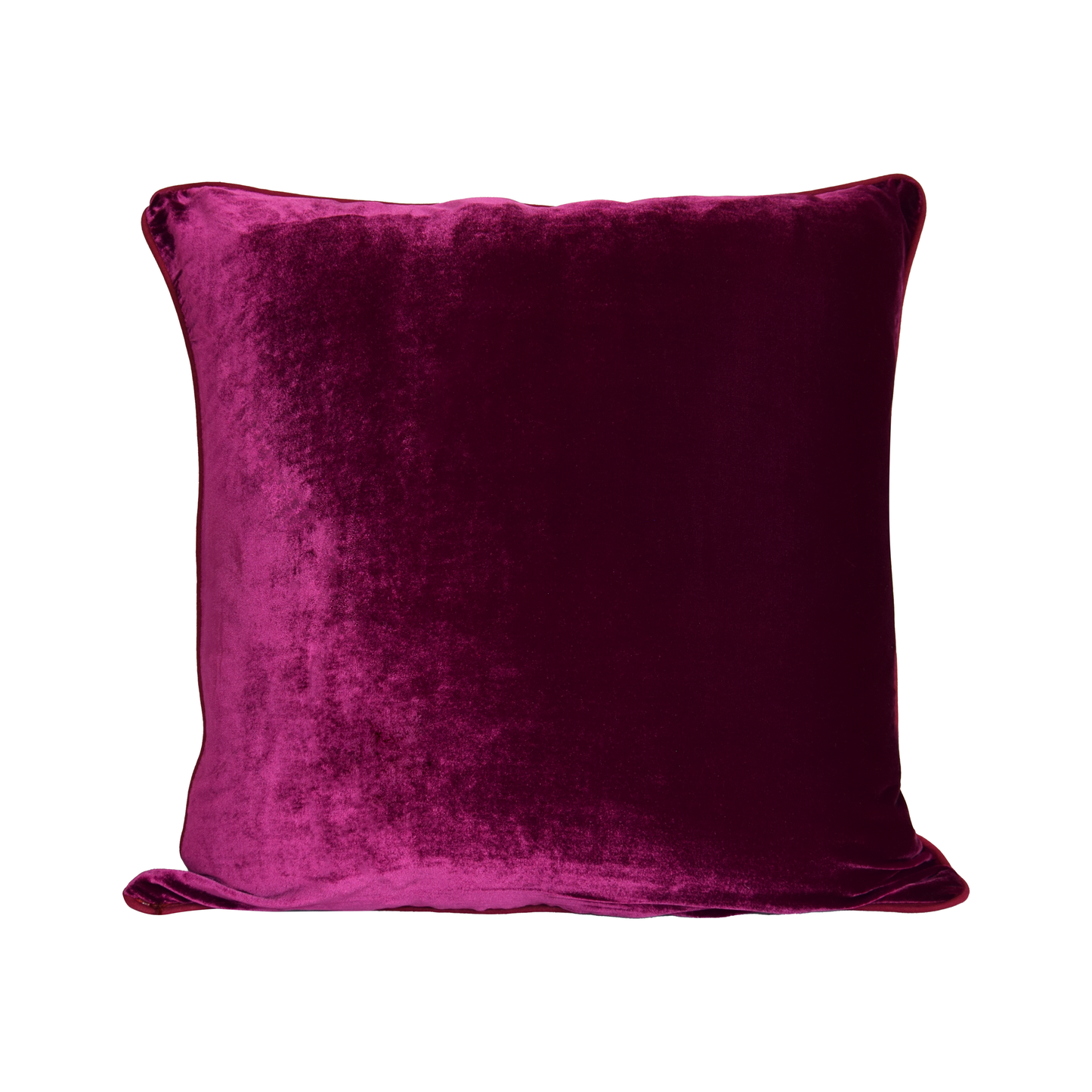
The back is finished in sumptuous French silk velour, creating a luxurious interplay of colour, texture, and heritage - a bold statement piece that beautifully fuses Indonesian artistry with European refinement.
Each cushion is made to order, allowing time for careful craftsmanship and attention to detail. Your piece will be ready for shipping within 15 working days from the date of order.
It is a luxurious and exquisite gift for the ones you cherish most, or for yourself. We invite you to place your order now.
---
Dimensions: 50 cm x 50 cm. Materials used for the front of the cushion: Handwoven cotton with artisanal natural dyes. Materials used for the back of the cushion: French silk velvet. All of our cushions are assembled in Paris, France. Specialised dry clean only. Kindly note the insert is not included. SKU: BFV001
---
The Minahasa people of North Sulawesi carry a textile heritage shaped by centuries of cultural exchange and a refined sensitivity to the natural world. Among their most celebrated craft forms is the weaving of intricate ceremonial textiles used in rituals of passage—birth, marriage, and the elaborate mortuary feasts known as kematian—where cloth served not merely as adornment but as a material expression of social identity. The geometric precision of Minahasan woven patterns reflects a cosmological worldview in which order, symmetry, and meaning are inseparable from aesthetic beauty.
The cultural vitality of the Minahasa was shaped in part by their long engagement with external trade networks—including Portuguese, Spanish, and Dutch contact—which introduced new dye materials and design vocabularies while leaving the core weaving logic distinctly local. Scholars of Indonesian material culture have noted the remarkable persistence of traditional motifs in Minahasan cloth, even as surface aesthetics adapted to changing times. It is this quality—an enduring inner structure dressed in evolving form—that speaks most directly to the philosophy behind our artisanal cushion fabrics: heritage that lives, breathes, and remains beautiful through transformation.
---
French Textile Heritage
No account of French textiles gets far without Lyon. Louis XI moved to establish silk manufacture there in 1466, but opposition from merchants sent the venture to Tours, where it never really took root. The industry properly began under François I, whose letters patent of 1536 settled two Piedmontese merchants, Étienne Turquet and Barthélemy Naris, in the city; a monopoly on raw silk imports followed in 1540. A century later, under Louis XIV, Lyon's silks, velvets and brocades had become a language of court power and national standing. Floral motifs, baroque scrollwork, and eventually the pastoral scenes of Toile de Jouy — printed at Jouy-en-Josas from 1760 — clothed palaces, churches and great houses, until textile design and French luxury were difficult to tell apart.
That refinement rested on trade corporations and family ateliers where technique moved from hand to hand across generations. Lyon's master weavers worked the drawloom, a demanding machine that required a second worker to raise the pattern threads, to make figured silks — the labour that Jacquard's invention would later absorb in 1804. Alençon, in Normandy, grew its needle lace after Colbert established a royal workshop there in 1665; Arras, in Artois, was known from the seventeenth century for fine white bobbin lace. Something of this survives commercially: Tassinari & Chatel (1680) and Prelle (1752) still reweave patterns from their own historic archives for Versailles and other palaces, using period records and hand looms alongside contemporary equipment, while Hermès has its tie silks woven and finished in the Lyon region.
Share