Alexander Mandagie Paris
Dusty Rose Italian Silk and Baduy Handwoven Fabric.
Dusty Rose Italian Silk and Baduy Handwoven Fabric.
Couldn't load pickup availability
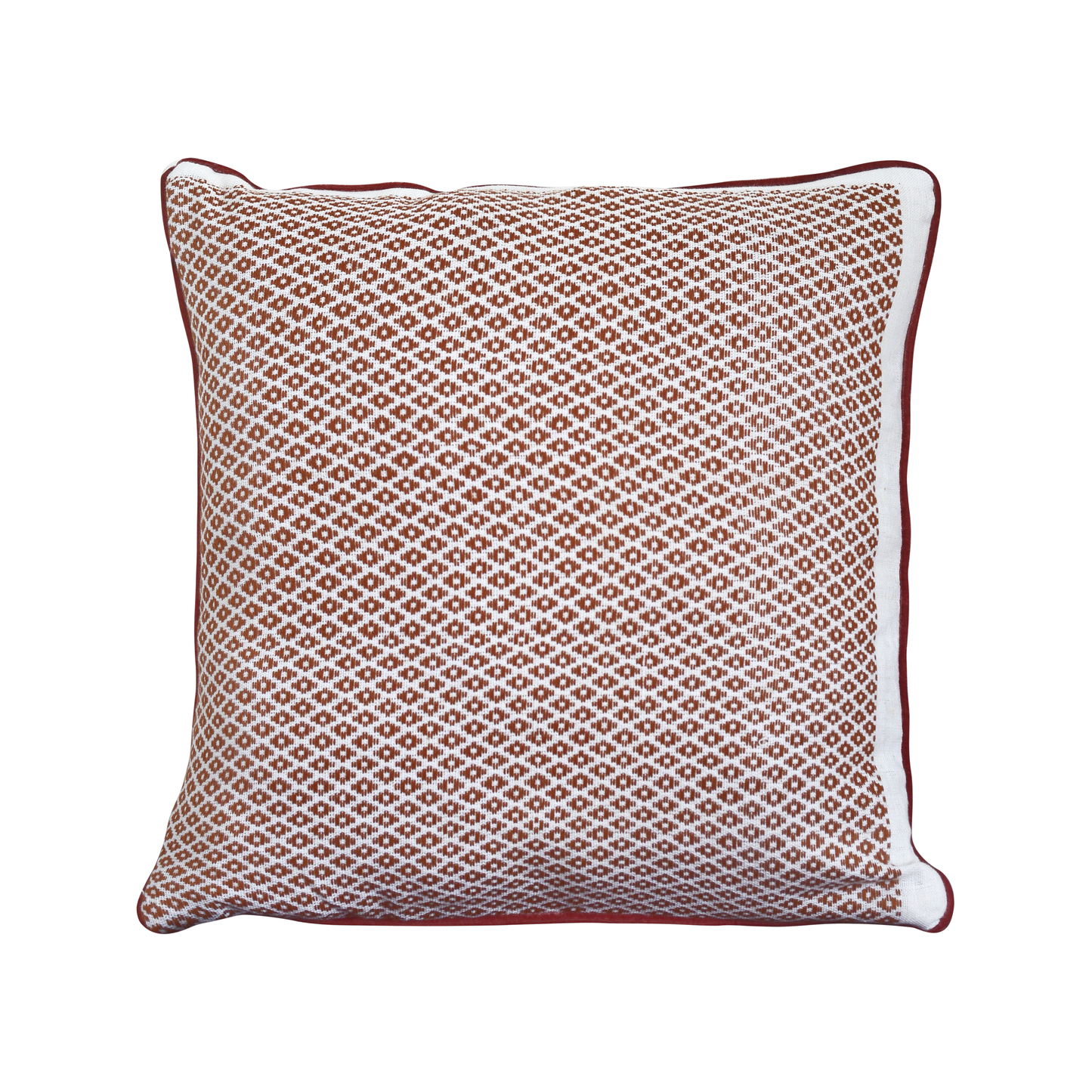
This timeless, elegant cushion will transport you to Italy, where the silk was printed with a pattern of peacocks, birds, and florals in grey and white set against a dusty rose ground, and trimmed with a contrasting dark-red piped edge. Its reverse is handwoven cotton, requiring more than 200 hours of work by Baduy artisans in West Java, Indonesia, and is coloured with natural dyes derived from local trees and leaves.
Each cushion is produced to order, allowing time for meticulous craftsmanship and close attention to detail. Your piece will be ready within 15 working days of your order. A treasured gift for yourself or for someone dear to you — we warmly invite you to order today.
Dimensions: 45 cm x 45cm. Materials used for the front of the cushion: Hand-drawn cotton made by artisans. Materials used for the back of the cushion: Italian silk velvet. All of our cushions are assembled in Paris, France. Specialised dry clean only. Kindly note the insert is not included. SKU: IFV1
---
Italy’s textile heritage is not one single school but a network of regional crafts, especially silk in Lucca, Venice, Florence, Bologna, Genoa, Milan, Naples, and later Piedmont, alongside wool and linen traditions in other centres. Scholarly surveys trace the rise of Italian silk from the medieval period into the early modern era, when guild regulation, specialized dyeing, complex weaving, and finely figured cloth made Italian production central to European luxury.
In interior design, Italian textiles carry prestige because they embody technical discipline rather than ornament alone: controlled sheen, precise weave structure, and a long association with civic wealth, patronage, and ceremonial use. A cushion made from Italian fabric is therefore not just decorative; it is a compact expression of a culture that has long treated cloth as architecture for the body and the room, giving a living surface to memory, skill, and proportion.
---
One well‑recorded strand of Baduy pantun concerns the origin of the Baduy themselves through the figure of Batara Cikal, said to be a crown prince of Pajajaran who withdrew into the forest that is now the Baduy reserve. In the Pantun Bogor tradition, when Pajajaran fell, a group of 20 followers, led by Ki Santang as the head, became separated from the main retreating army. They settled in the forbidden forest, where Ki Santang and his wife became the first puun (spiritual leader) of Baduy, while nine of his guards founded the three original villages of Cikeusik, Cikertawana, and Cibeo. Through pantun, the Baduy thus remember themselves as custodians of a sacred lineage that chose isolation to preserve a way of life aligned with ancestral law.
Share