Alexander Mandagie Paris
Pink and Blue Sikka Flores with Italian Silk Velvet
Pink and Blue Sikka Flores with Italian Silk Velvet
Couldn't load pickup availability
This beautiful cushion features an exquisite front panel made from authentic Sikka fabric, handwoven by skilled artisans in Sikka, Flores, Indonesia. Renowned for its intricate ikat technique, Sikka fabric is crafted using natural cotton fibres and plant-based dyes, with each pattern reflecting the rich symbolism, ancestral stories, and vibrant traditions of the Sikka people. The creation of a traditional handwoven cloth piece consumed 200 man-hours of the artisan's labour across a two- to three-month period.
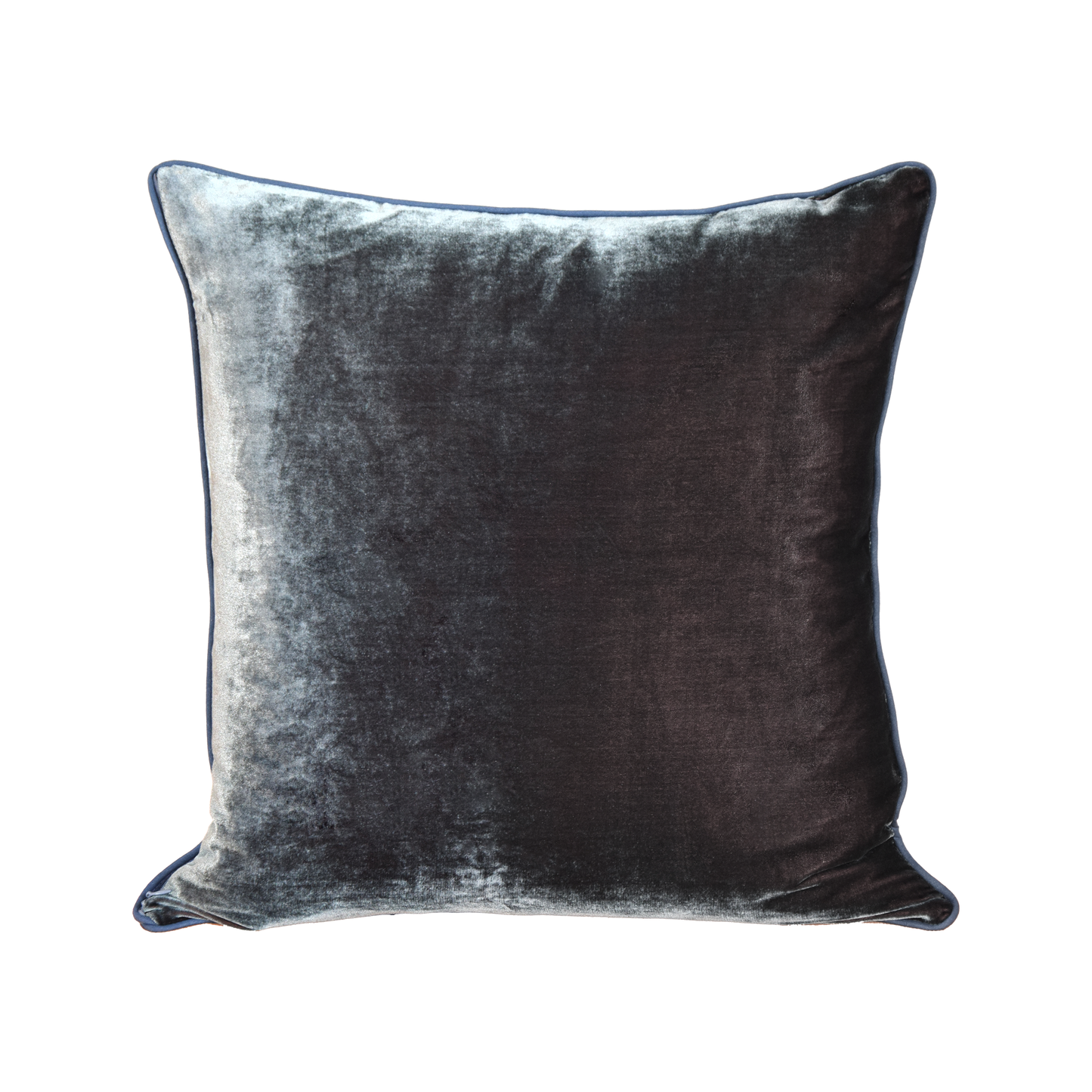
The back is finished with luxurious Italian silk velour, offering a refined contrast in both texture and colour and creating a harmonious blend of Indonesian heritage and European elegance, making this cushion a truly unique and meaningful accent for your home.
Each cushion is made to order, allowing time for careful craftsmanship and attention to detail. Your piece will be ready for shipping within 15 working days of the order date.
It will be the most unique present for you, your family, and your colleagues. We invite you to place your order now.
---
Dimensions: 50 cm x 50 cm. Materials used for the front of the cushion: Handwoven cotton with artisanal natural dyes. Materials used for the back of the cushion: Italian silk velvet. All of our cushions are assembled in Paris, France. Specialised dry clean only. Kindly note the insert is not included.SKU: FEV001
---
The island of Flores in East Nusa Tenggara is home to one of Indonesia's most extraordinary concentrations of weaving cultures, where each regency—Manggarai, Ngada, Ende, Lio, and Sikka—maintains a distinct textile vocabulary rooted in clan identity, ritual function, and a profound relationship with the ancestral spirit world. The dominant technique across the island is ikat, in which warp threads are resist-dyed in complex patterns before weaving begins, a process that requires a form of mental visualisation that textile scholars have compared to architectural planning: the weaver must see the finished cloth in the unprocessed thread. This quality of foresight—of beauty anticipated and then realized—places Florenese ikat among the most intellectually demanding of all textile arts.
In the Lio and Sikka regions, ikat cloths known as lawo (women's sarong) and lipa (men's hip cloth) are distinguished by dense, intricate figurative motifs—horses, crocodiles, ancestors—executed in earthy crimson, indigo, and cream against a dark ground. These are not decorative choices made for aesthetic pleasure alone; each motif carries genealogical information about the weaver's clan and spiritual alliances. The result is cloth that functions simultaneously as autobiography, cosmology, and art—a convergence that quietly defines the most extraordinary textiles in our heritage collection.
---
Above the coast at Maumere, in eastern Flores, a forested hill rises to a little over eight hundred metres. Near its summit lies the hamlet of Dobo — its full name, Dobo Dora Nata Ulu, means the peak of Dobo, the first village. There, far from any shore, the Sikkanese keep a ship. It is made of bronze, it is about the length of a forearm, and twenty-two small figures crowd its deck and its oars, among them a gong and a rooster to mark the hours.
How a ship came to rest on a mountain is answered not by archaeology but by Kleteng Latar, the parallel lyric verse in which the Sikkanese carry their origins. The verse tells of a great vessel that set out from a country across the sea — the telling names it differently — carrying people who understood farming and were looking for soil rich enough to settle on for good. Before they sailed, they bound themselves by oath. They would keep the customary law, respect the land they passed through, and, above all, raise anchor before the sun came up. Break the oath, and they would be made small.
Their voyage was long. It took them through Malacca and Bima, along the northern coast of Flores, and at Waipare their anchor parted from the ship and was left behind; the stone that marks the place is still pointed out. They carried on inland. At one village and then another they were not offered tobacco and betel — the courtesy that says a guest is welcome — and so they did not stay. Somewhere on that journey, the great hull struck a hill and split it clean in two.
Then they came up to Dobo. Here at last the ground was level and good, the village prosperous, the welcome real. And here, in the ease of arriving somewhere worth staying, they let the sun rise before they had lifted the anchor. The verse does not elaborate. It simply repeats, as adat verse does: they overslept at Dobo, and at Dobo the ship became bronze.
What is remarkable about the story is that nothing is lost. No one drowns, and no one is punished beyond the shrinking itself. The ship is not destroyed — it is reduced, and kept, and it is still doing something. The people of Dobo hold that it governs the weather over the hill, and that if it were ever carried away, rain and violent wind would come down and tear apart the gardens. So it stays. A guardian of the artefact lives close by, and a visitor who wishes to see it asks the ancestors first, with an offering of betel and tobacco, and is sometimes granted permission and sometimes not. The gateway into the village carries a greeting in the Sikka language: Uhet Dien Dat Hading — welcome, the door is open. It is the courtesy the crew were denied elsewhere, and were given here, and to a lost ship too.
---
Italy's textile heritage did not develop as a single tradition but as a web of regional crafts. Silk-making took hold in centres such as Lucca, Venice, Florence, Bologna, Genoa, Milan and Naples, with Piedmont rising later, while other towns built their reputations on wool and linen. Scholarly surveys trace Italian silk from the Middle Ages through the early modern period, when guild oversight, specialised dyeing, intricate loomwork, and richly patterned cloth put Italian output at the heart of European luxury production. This history is set out in La seta in Italia dal Medioevo al Seicento: Dal baco al drappo (2000) and in 5000 Years of Textiles (1993), the latter situating Italian silks within the wider story of European textile innovation.
In interior design, the standing of Italian textiles rests on technical discipline rather than decoration alone: a controlled lustre, exacting weave structure, and centuries of association with civic wealth, patronage and ceremony. A cushion cut from Italian cloth is thus more than an ornament — it is a small distillation of a culture that has long treated fabric as a kind of architecture for the body and the room, lending a living surface to memory, craft and proportion.
Share